

Prepared by: Middle East Centre for Training and Development (MECTD)
Date: October 2025
Executive Summary

This report examines delivery riders’ perceptions of the Roads and Transport Authority’s (RTA) new land-use regulation[1] introduced on 1 November 2025, requiring delivery motorcycles to remain within lower-speed lanes on major roads in Dubai. The study draws on primary survey data collected from 34 delivery riders employed within a structured corporate environment.
Findings indicate that riders demonstrated full awareness of the new rule, largely due to company briefings and RTA’s communication efforts. Participants recognised the regulation’s safety benefits, noting that remaining in lower-speed lanes may reduce exposure to fast-moving vehicles and unpredictable lane changes.
Despite this positive perception, riders expressed concerns about increased delivery times, unrealistic app-generated time estimates, and pressure from customers and companies when delays occur. Without adjustments to delivery-app systems and customer expectations, these concerns may affect compliance.
Overall, the findings show that while RTA’s regulation is widely supported, its practical implementation requires better alignment between regulatory measures, delivery-company operations, and platform technology to ensure that safety benefits are realised without creating additional challenges for riders.
[1] Regulating Delivery Bike Use on Roads Starting First of November 2025
https://www.rta.ae/wps/portal/rta/ae/home/news-and-media/all-news/NewsDetails/regulating-delivery-bike-use-on-roads-starting-first-of-november-2025
First: Contextual Background
Globally, delivery riders face higher road-risk exposure due to speed differences, lane competition, and limited physical protection. International research highlights lane positioning as a critical factor in motorcycle crash severity (World Health Organization, 2023).
In the Gulf region, academic reviews report growing concern over delivery-rider safety in dense commercial zones. These studies emphasize that regulatory interventions must be supported by improved public awareness and technological adaptation to achieve effective behavioural change (Gulf Traffic Safety Journal, 2024).
Second: Importance of the Study
In the UAE, similar safety patterns have emerged. Reports from Dubai Police highlight that the delivery-motorcycle sector was involved in 854 accidents in 2024, rising to 962 accidents in 2025 to date (The national, 2025). These figures reflect not only injury and fatality risks but also broader economic and social costs—medical treatment, compensation, insurance, and public perception.
Against this backdrop, the RTA introduced a mandatory rule requiring delivery riders to remain in lower-speed lanes to reduce exposure to high-risk traffic. This aligns with a wider global shift toward infrastructure-based behavioural regulation as a method of reducing road injuries (International Transport Forum, 2021).
This study assesses rider awareness, perceptions, and practical experiences in adapting to the new rule through primary survey data.
Third: Research Methodology
The study employed interviewer-administered surveys with thirty-four (34) delivery riders in Dubai. This method ensured clarity, especially given the multilingual and literacy-diverse backgrounds of participants. Interviewer-led surveys are widely used in transport-safety research to enhance data accuracy and reduce misinterpretation (Global Road Risk Observatory, 2022).
The sample represents a focused case study within a regulated corporate environment. While findings cannot be generalised across the entire sector, such case studies are valuable for understanding behavioural response within specific organisational settings.
Fourth: Findings
A- Respondent Profile: Working Experience
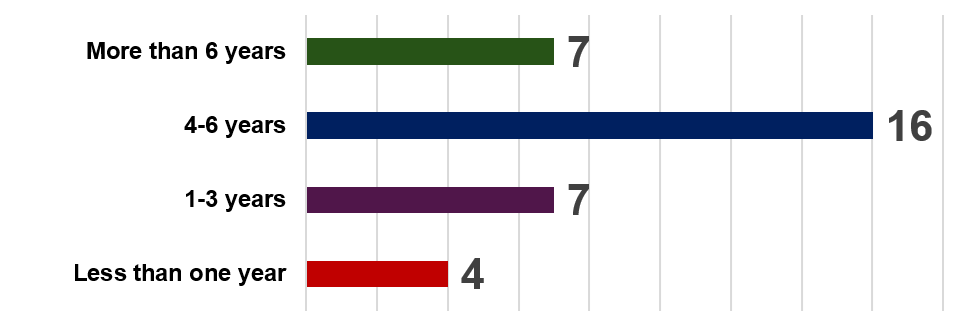
- 47% (16 riders) have 4–6 years of experience.
- 12% (4 riders) have less than one year of experience.
- 20% (7 riders) have more than six years of experience.
- 20% (7 riders) have less than three years of experience.
B- Awareness and Understanding of the New Rule

- 100% (34 riders) reported full awareness of the new rule.
- Riders were informed through company briefings and RTA training sessions conducted over more than two weeks.
- All respondents stated that the rule’s purpose and requirements were clear.
C- Perception and Acceptance
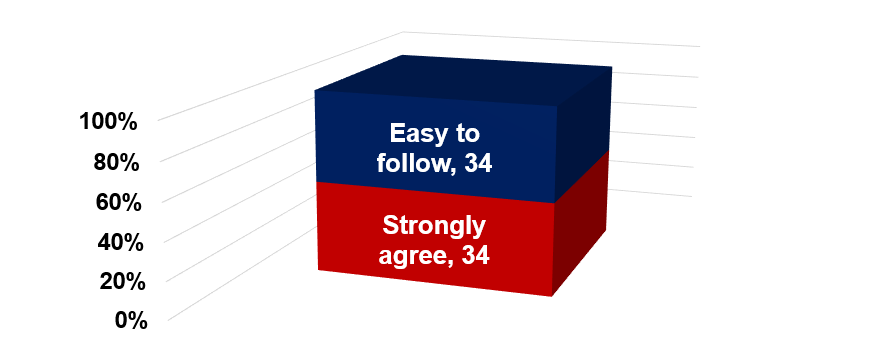
- More than 90% (31 riders) strongly agreed that the new rule improves safety.
- Remaining 10% (4 riders) agreed.
- Almost all riders strongly agreed that the rule is easy to follow and does not hinder daily work from a safety perspective.
D- Effectiveness and Practical Challenges
Riders expressed strong concerns regarding:
- Delivery delays caused by staying in lower-speed lanes.
- Increased complaints from car drivers in other lanes.
- Customer pressure and penalties due to unadjusted delivery times.
- Delivery apps providing delay alerts for weather or prayer times, but not for traffic-related delays specific to riders.
These issues may create compliance challenges despite overall support for safety measures.
E- Support for the Rule
- 100% (34 riders) strongly support RTA’s aim to reduce fatalities and injuries.
F- Requirements for Better Implementation
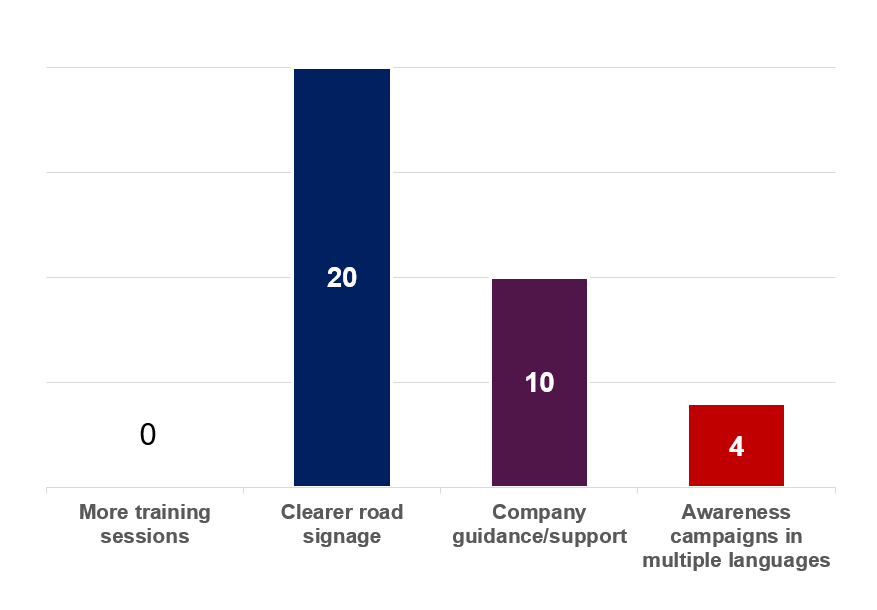
Riders suggested:
- 58% (20 riders): Need for clearer road signage.
- 29% (10 riders): Company support through alerts similar to those for weather or prayer times.
- 12% (4 riders): Multi-language educational materials.
- 0% requested additional training sessions.
Fifth: Research Limitations
The sample size (34 riders) is not representative of the full delivery sector in Dubai, particularly as it includes riders from only one company. Time constraints also limited the inclusion of open-ended questions, since riders were often rushing between orders.
Sixth: Conclusion
The RTA’s new lane-use rule is widely understood and strongly supported by delivery riders. Riders recognise its safety benefits, yet practical challenges—especially delivery delays, customer expectations, and app-design limitations—may hinder smooth implementation. To maximise the rule’s effectiveness, coordination is needed between RTA, delivery companies, and platform developers to align system features, timing expectations, and customer communication with the realities of rider mobility.
Seventh: Recommendations
Based on the findings of this study, several practical recommendations can enhance the effectiveness of RTA’s new land-use rule and support smoother implementation across the delivery sector:
A- Improve Traffic-Related Delay Notifications in Delivery Apps
Delivery platforms should integrate automated notifications that reflect:
- Live traffic congestion affecting motorcycles
- Slower movement in lower-speed lanes
- Peak-hour delays
This will help align customer expectations with real road conditions and reduce pressure on riders.
B- Strengthen Coordination Between RTA, Delivery Companies, and Platform Developers
A structured collaboration mechanism should be established to:
- Communicate regulatory changes
- Adjust delivery time algorithms
- Share road-safety data
- Develop unified operational guidelines
This will ensure consistency across the sector.
C- Enhance Road Signage for Lane-Use Compliance
Clearer, more prominent signage can help:
- Riders identify designated lanes quickly
- Reduce confusion during peak traffic
- Increase overall compliance and road safety
D- Expand Multi-Language Awareness Materials
Given the diverse workforce, RTA and companies should develop awareness content in multiple languages, including:
Hindi – Urdu – Bengali – Filipino – Arabic
This supports full comprehension of the regulation’s requirements.
E- Provide Incentive-Based Compliance Systems
Riders often face penalties or pressure for delays. Instead, companies should consider:
- Safety based performance incentives
- Recognition for compliance (employee of the month)
- Rewards towards zero violation riders